New Product Introduction
New Product Introduction Breaks Down When Critical Gaps Are Not Resolved Before Launch
Drawings are done.
Materials are ordered.
Launch date is set.
A new product can be released and still not be ready to run.
If the build isn’t defined,
If the process isn’t stable,
If the production isn’t ready,
Then new product introduction only creates chaos.
Output drops.
Rework spikes.
Engineering gets pulled back in.
You don’t have a launch. You have a recovery operation.
A product is only launched when the plant can run it
predictably, at target output, without firefighting.
Until then, every day burns time & money.
We identify where the launch will break before it does and define what must be fixed first.
Where NPI Breaks Down
New Product Introduction usually does not fall apart in one big event.
It breaks down because open issues stay open too long, then all show up at once when the product hits the floor.
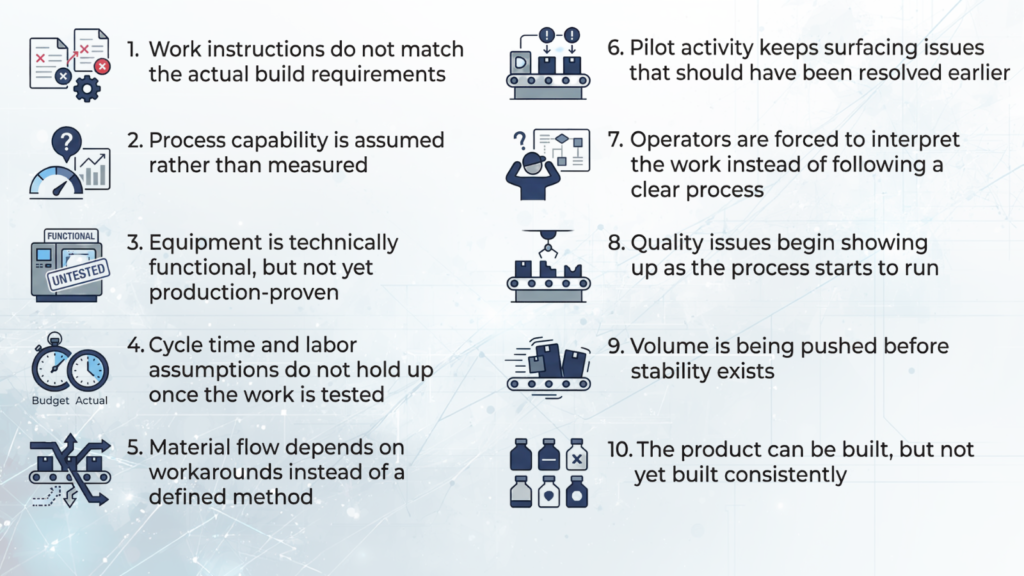
These are manufacturing readiness gaps.
The product may be moving forward, but the process behind it is not ready to support it.
What Trueworx Works On
A lot of NPI trouble comes from one basic problem: the product definition is farther along than the manufacturing definition.
Trueworx helps close that gap so the plant is not trying to figure out how to build the product after launch pressure has already started.
What That Work Looks Like
This work happens in the details that decide whether a launch runs cleanly or turns into daily disruption.
Before Launch
- Review the planned build method before release to production
- Compare design intent to actual manufacturing requirements
- Break down the process sequence and find missing steps or weak points
- Review cycle time, labor content, and rate assumptions against real production conditions
- Verify tooling, fixtures, equipment, material flow, and work instructions for repeatable use
During Early Ramp
- Support pilot builds, trial runs, and startup activity
- Track first-pass yield, scrap, and repeated misses closely
- Stabilize equipment and process issues before they spread
- Keep open launch issues from bouncing between functions without ownership
- Close the gap between launch activity and normal production control
The goal is to move the product into production in a way the plant can actually sustain.
When Trueworx Is a Fit
Trueworx is a fit when a product is moving toward launch, but the manufacturing side is not ready to carry it cleanly.
The product can be built, but the process is not stable
Work instructions, tooling, or process assumptions are not holding up on the floor
Early ramp is surfacing scrap, delay, and repeated firefighting
The handoff from design into production is still messy
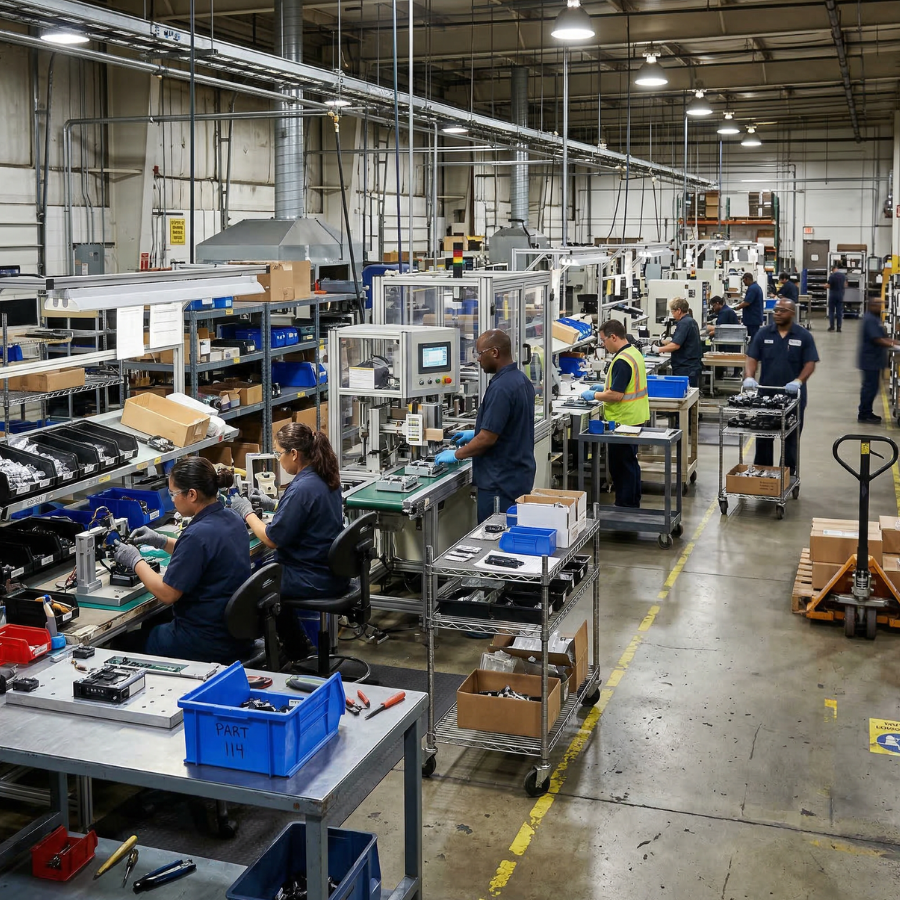
In situations like these, launch performance is usually being limited by something specific inside the manufacturing process. That limiter has to be identified and corrected before it keeps hitting output, quality, and delivery.
Move the Product Into Production With Control
New Product Introduction problems do not all come from the same place.
In one plant, the limiter is process definition. In another, it is tooling, material flow, documentation, ownership, or launch handoff.
The Manufacturing Diagnostic identifies what is actually limiting launch performance so the right work gets done first.
If a new product is moving toward production and the manufacturing side still is not fully worked through, Trueworx helps identify the gap, correct it, and build a launch the plant can hold.