About
The Background Behind the Work
Tim Corcoran built his background in automation equipment design and the bring-up of complex manufacturing systems. That work includes pilot production, production ramp, and line stabilization across consumer electronics and complex capital equipment builds. These are the environments where products, processes, and equipment have to prove themselves under real operating pressure.
Much of that work was done inside Jabil’s automation and capital equipment organizations, on programs tied to Apple and multiple capital equipment manufacturers including Xcerra. Tim’s broader background also includes work connected to Google and other large Silicon Valley consumer electronics companies.
This was not just oversight work. Tim was on the floor, building automation equipment, bringing pilot production systems online, troubleshooting failures during bring-up, improving line performance during ramp, and defining how complex products and equipment should actually be built in production. That work also required leading engineering and manufacturing teams across multiple sites globally. Real improvements depend on the team being involved in the fix and carrying it forward after the work is done.
Different industries, different products. The same reality in every one of them: a system being technically functional means very little if it cannot perform in production.
That is the foundation Trueworx operates on.
What Years on the Floor Have Made Clear
Working and performing are not the same thing.
A line can be running and still be underperforming. Output may be unstable, quality may drift, or the team may be intervening constantly just to hold it together. Running is not the same as performing.
The real limiter is not always the obvious one.
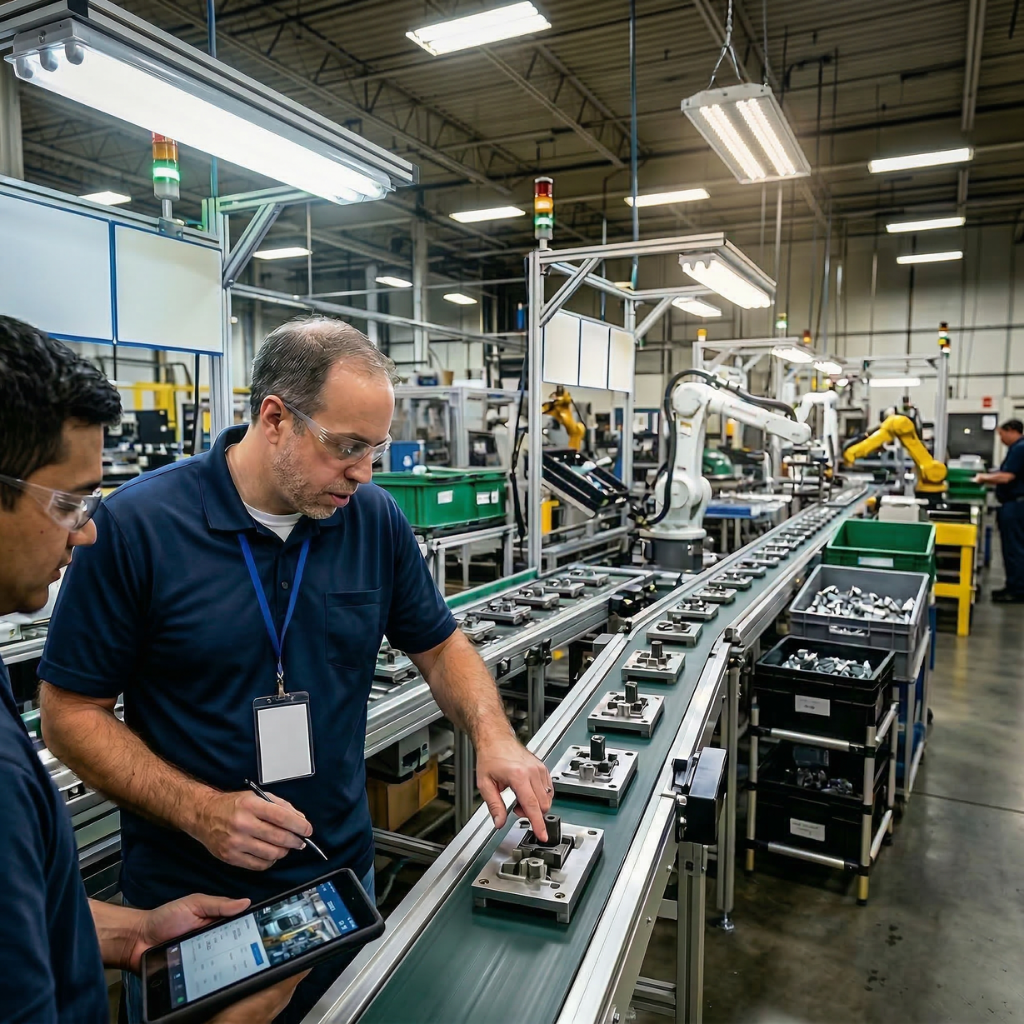
When performance falls short, the cause is somewhere inside the system. Finding it requires going to the floor and seeing the operation as it is actually running, not as it looks on a report or sounds in a meeting.
Pilot exposes reality.
Pilot is where assumptions meet operating conditions. Process gaps, equipment issues, handoff failures, and missing structure show up quickly once the system has to actually run. This is where the real state of readiness becomes visible.
Automation cannot rescue a weak process.
Automation strengthens a capable process. It cannot fix one that is unclear, unstable, or poorly defined. Applied to a weak process, it usually creates a more expensive problem.
“In manufacturing, there is a big difference between a system that works and one that actually performs.”
-Tim Corcoran
Start With the Manufacturing Diagnostic
The first step is identifying what is actually limiting performance.
That is what the Manufacturing Diagnostic is designed to do.