Process Optimization
A process can be running every day and still be limiting performance.
Parts move. People stay busy. Orders go out. That does not mean the process is performing the way it should.
In many manufacturing operations, the same process that is supposed to create output is also quietly creating loss. Throughput stays below potential. Quality problems keep coming back. On-time delivery takes more effort than it should.
We work inside manufacturing operations to identify what is limiting performance, correct it at the source, and make the improvement hold in daily production.
Process Problems Usually Show Up in the
Results
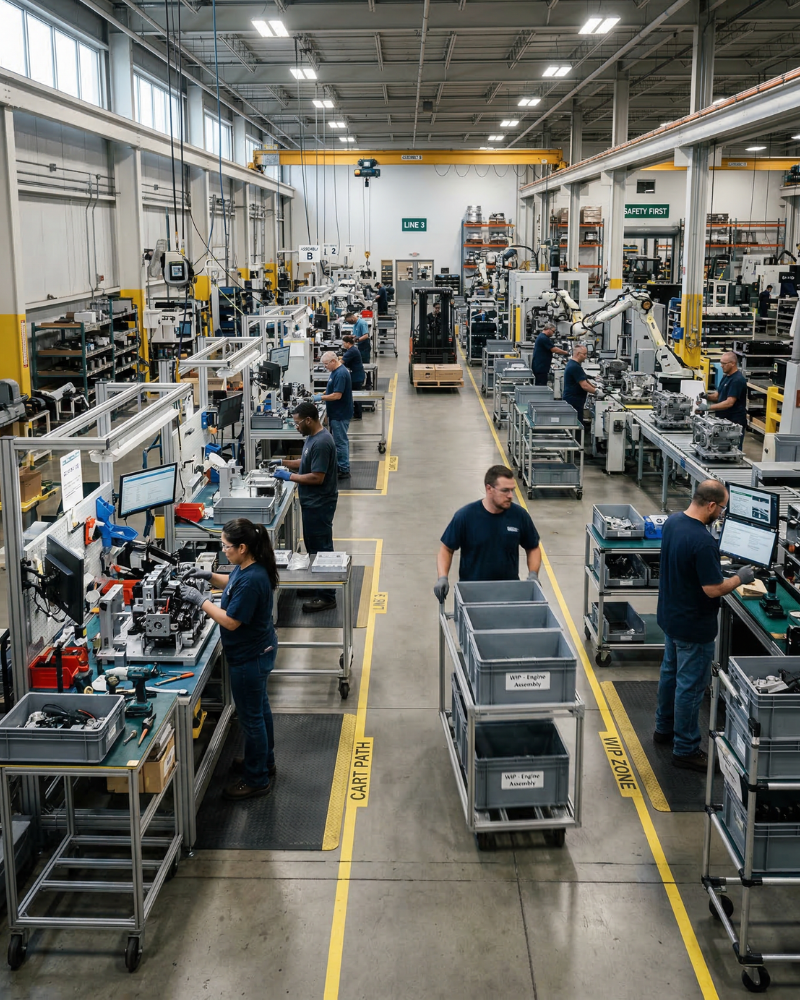
When a process starts underperforming, the first signal is usually in the results. Output slips. Scrap rises. On-time delivery gets harder to protect. Then the real work is tracing those results back through the floor to find where the loss starts.
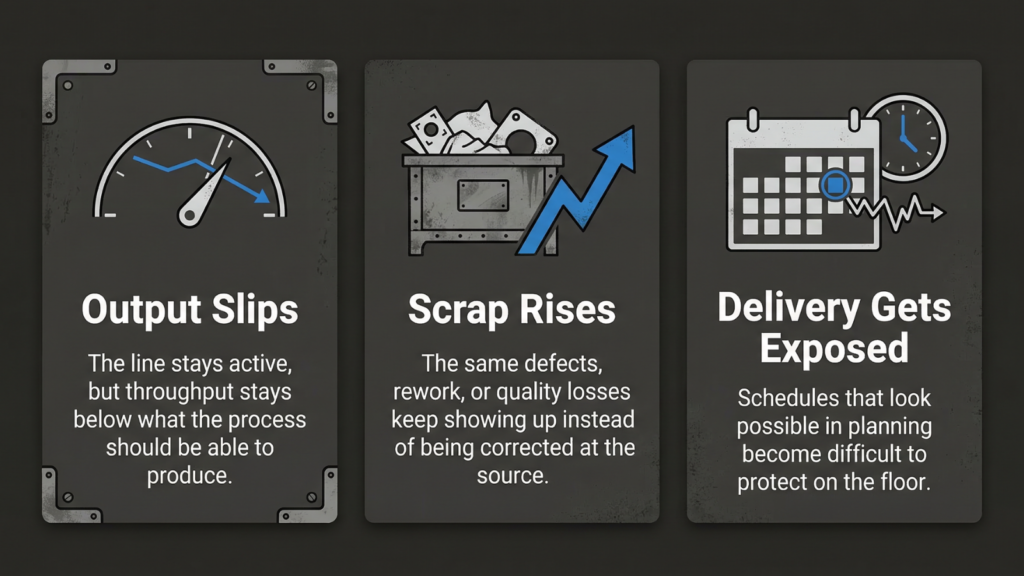
A line can look busy but still miss output. A cell can hit its number one day and fall short the next. Rework can keep showing up in the same place. One step may keep setting the pace for everything behind it. The schedule may look possible in planning, but the floor keeps fighting it.
Over time, the operation starts compensating with effort. More supervision. More expediting. More workarounds. More dependence on specific people to keep things on track.
That is not stable performance.
That is the process absorbing its own weakness.
What Those Results Usually Mean
Manufacturing performance is not random.
If throughput is inconsistent, quality keeps drifting, or delivery depends on constant intervention, there is a cause in the process.
The limiter may not be the most visible problem.
It is the one controlling output.
The process may be unbalanced. Standard work may be unclear. Handoffs may be weak. A problem may be getting created in one step and paid for two steps later. Time and capacity may be lost every shift through waiting, extra handling, rework, poor layout, or weak flow between operations.
Process Optimization is the work of identifying what is limiting output, correcting it at the source, and making the improvement hold in daily production.
How Trueworx Works Inside The Process
Trueworx does not approach process problems from a conference room.
We do not assume. We observe.
The work starts where production happens, on the floor, at the line, at the cell, and across the process from one step to the next. That means walking the process end to end, tracing product flow, watching where WIP builds, seeing where changeovers slow the pace, standing at the constraint, and looking at how the operation actually runs under normal conditions.
The objective is to understand how the process is actually behaving, identify what is controlling output, and correct the conditions that are holding the operation back.
The same approach applies whether the work is inside your own operation or across a contract manufacturing relationship. If output, quality, or delivery are being limited, the job is the same: find what is controlling performance, correct it, and make it hold.
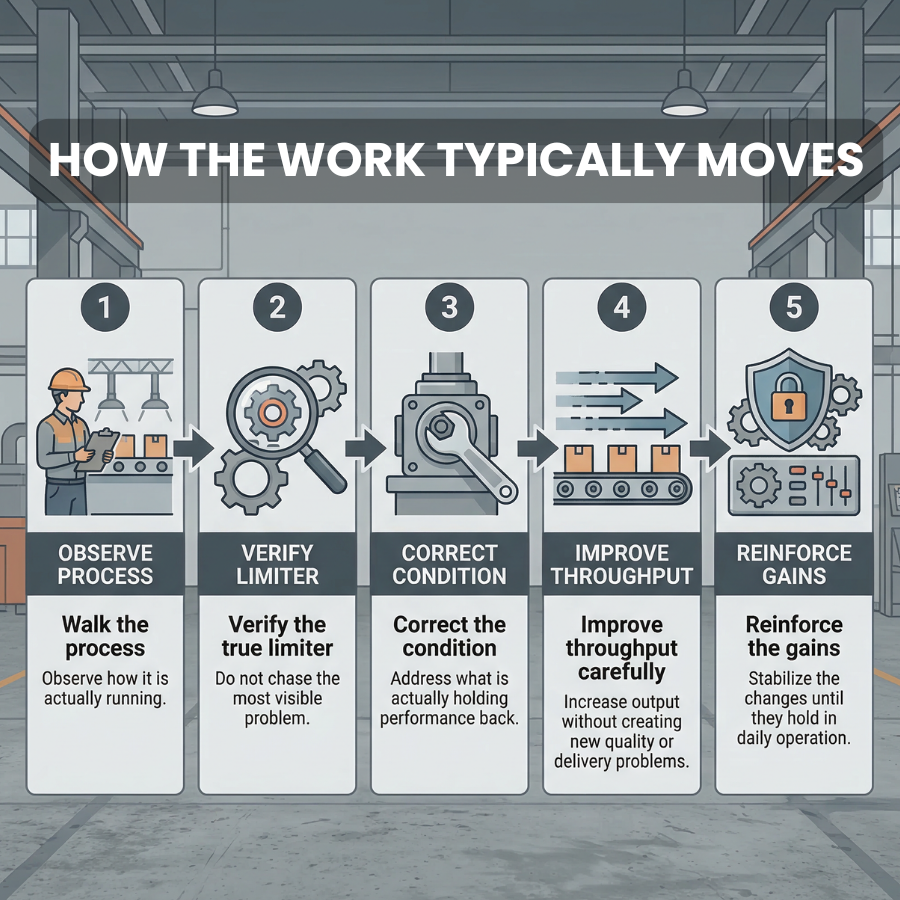
We typically work through the process in a simple way:
– Walk the process and observe how it is actually running
– Verify what is truly limiting output
– Correct the condition that is holding performance back
– Improve throughput without creating new quality or delivery problems
– Reinforce the changes until the gains hold in daily operation
This is not a workshop. It is not a slide deck. It is not a recommendation list handed over from the outside.
This is practical work inside a real operation. The point is not to talk about the process. The point is to improve the way it runs.
What Better Performance Looks Like
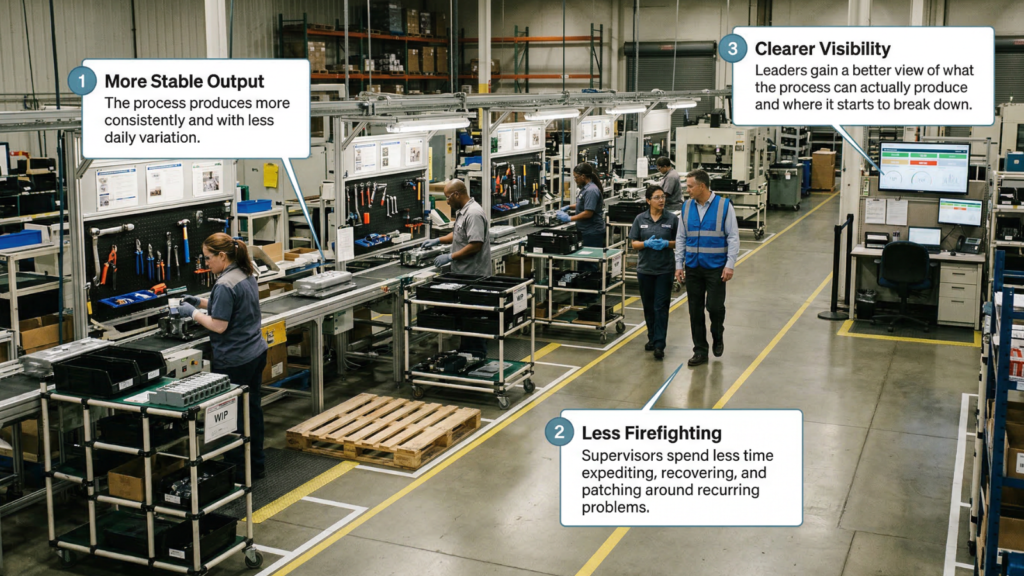
When the real limiter is corrected, the operation feels different.
Output becomes more stable. Quality stops failing in the same places. Flow improves between steps. Supervisors spend less time firefighting. Labor is used more effectively.
The plant spends less time recovering and more time producing.
Leaders get a clearer view of what the process can actually produce, where it starts to break down, and what needs to be corrected before output or delivery slips.
When Process Optimization Is the Right Fit
Process Optimization is usually the right fit when:
- Production is running, but output is not stable
- The same quality issues keep coming back
- One part of the process keeps dragging the rest of the operation behind it
- The schedule only holds together with expediting
- Labor effort is high, but flow is still weak
- The operation needs better throughput and quality without disrupting delivery
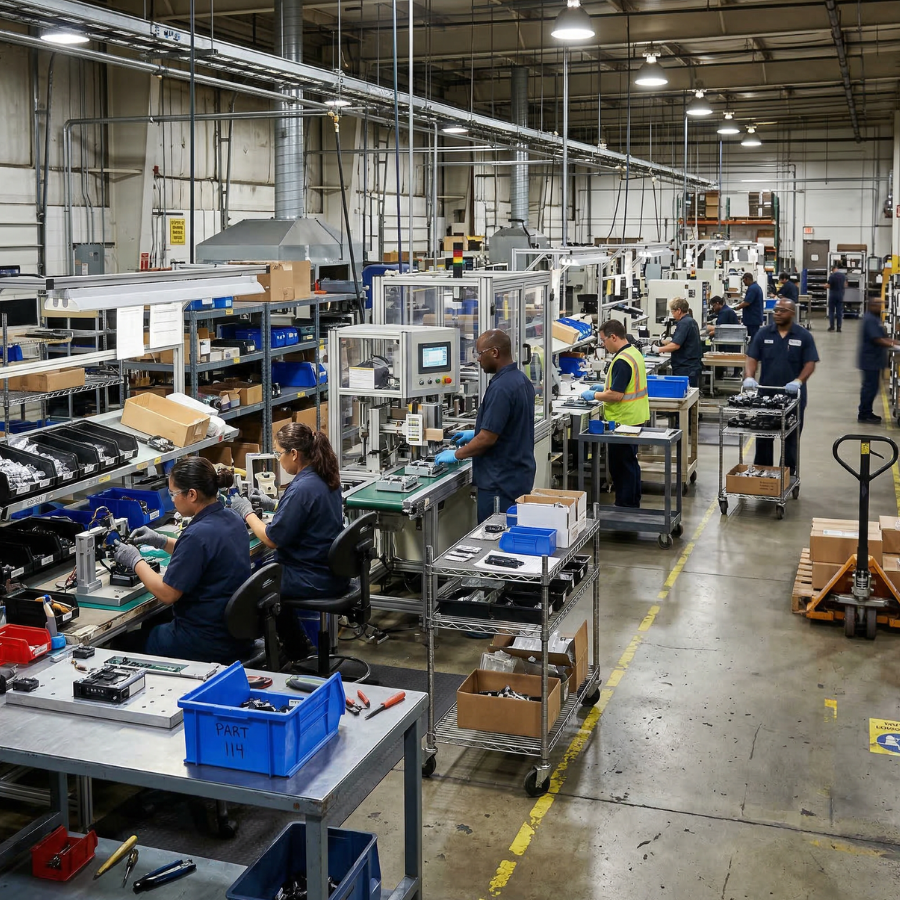
It does not require a highly automated facility. Many process problems exist in manual, semi-automated, and mixed operations. The same is true in contract manufacturing environments. In all of those cases, process control, flow, clarity, and repeatability matter.
Start with the Manufacturing Diagnostic
Every engagement begins with a Manufacturing Diagnostic designed to identify what is limiting performance and what should be addressed first.
If your process is running but output is inconsistent, quality keeps slipping, or delivery takes constant intervention to protect, the problem is not random.
Something in the operation is limiting performance.
The Diagnostic helps determine whether the work is process optimization, NPI, scaling, or capital — and what needs to be corrected first to improve output, quality, and delivery under real production conditions.
Start with the process. Find the limiter. Fix what is controlling output.